

From Resistance to Revelation: The Inner Journey of Writing a Transformational Book
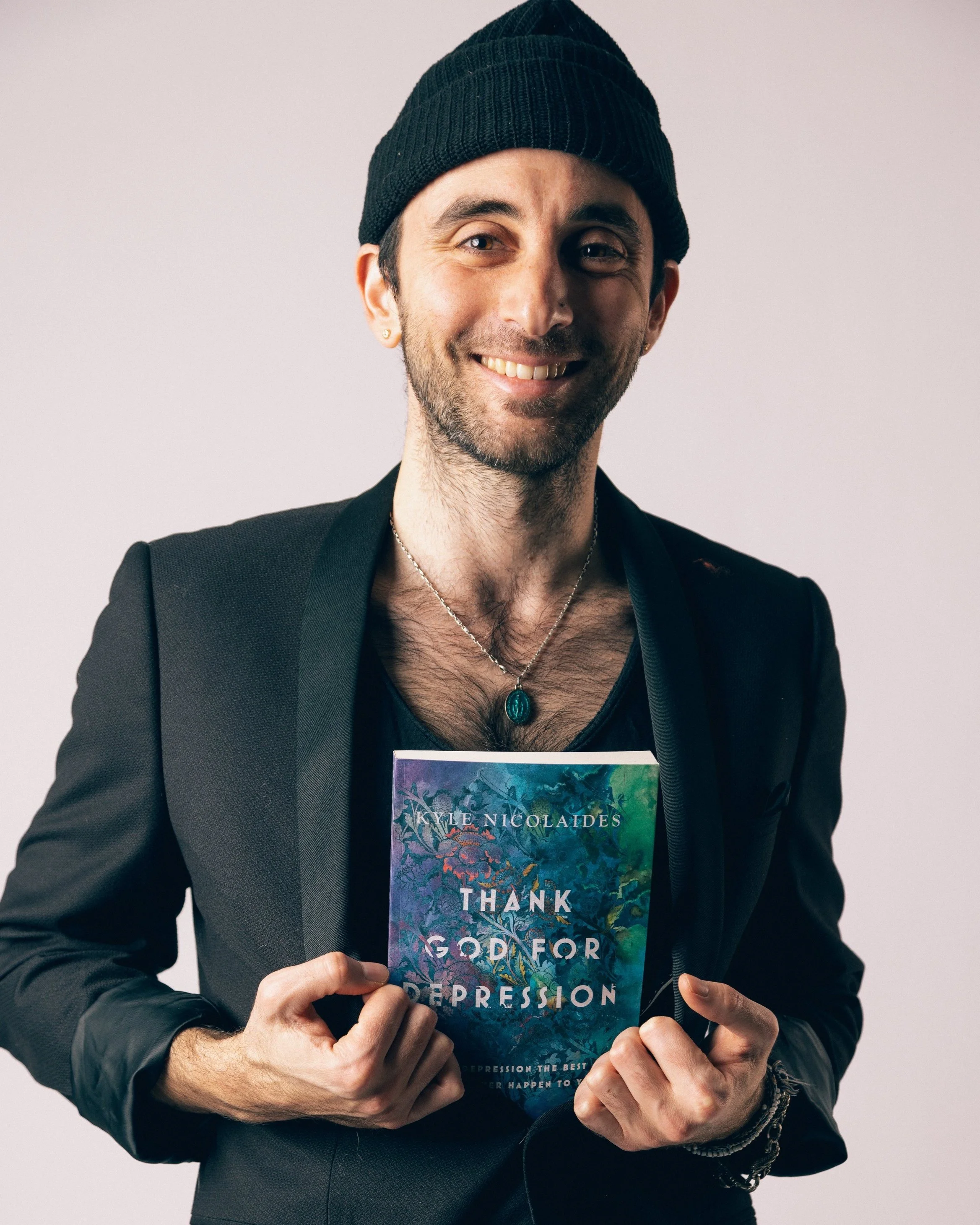
An Interview with Kyle Nicolaides, author of Thank God for Depression
Every transformational book begins long before the author ever types the first sentence.
It begins as a whisper. A nudge. A moment of recognition that: this isn’t just an experience I lived—this is something that wants to be shared.
In a recent podcast conversation, I sat down with musician and author Kyle Nicolaides, whose book Thank God for Depression: How to Make Depression the Best Thing That Ever Happened to You has resonated deeply with readers navigating mental health and healing.
What unfolded was not a tactical discussion about outlining or publishing strategies, but a rich, honest exploration of the inner journey of authorship—the emotional, spiritual, and relational thresholds an author crosses when writing a transformational nonfiction or memoir book.
This article is a debrief and expansion of that conversation, written for aspiring and emerging authors who feel called to write a book rooted in lived experience—and who may be encountering resistance, self-doubt, creative blocks, or uncertainty along the way.
If you are seeking memoir writing support, book coaching for memoir writers, or transformational nonfiction book coaching, this reflection is for you. And if you’d like further support reach out to learn about our author support programs.
The Moment You Realize “This Is a Book”
Kyle didn’t set out to write a book. Like many authors of transformational nonfiction, the idea emerged sideways—through journaling, unfinished blog posts, and creative fragments that refused to stay contained.
At first, he imagined writing a simple blog post about healing depression. But each attempt to distill the experience into something short and tidy failed. The ideas were too big. Too layered. Too alive.
Eventually, a realization landed: the reason this won’t fit into a blog post is because it’s a book.
This moment is familiar to many transformational non-fiction and memoir writers. The call to write often arrives not as clarity, but as friction. The content resists simplification. The story keeps expanding. The material asks for more time, space, and devotion than expected. Or the container in which we are imagining the work isn’t quite aligned yet.
From a transformational nonfiction book coaching perspective, this is often the first initiation: learning to listen when the work itself says, I am larger than you planned for.
Resistance is Not a Sign You’re Doing it Wrong
One of the most powerful themes in our conversation was the reframing of resistance—not as failure, but as feedback.
Kyle shared candidly about his early struggles with focus, capacity, and self-judgment. At the beginning, he could only write for ten or fifteen minutes at a time. Sitting down to write often triggered inner criticism, doubt, and a sense of inadequacy.
Many authors interpret this phase as evidence that they are “not real writers.” In reality, it is a normal—and necessary—part of the process.
Writing a transformational book requires more than technical skill. It asks us to sit with our inner world long enough for unresolved emotions, old identities, and protective strategies to surface.
From a memoir writing support standpoint, resistance is often a signal that something tender is being touched—which is asking to be met with curiosity and care.
Capacity is Built
A common myth among aspiring authors is that writers either have it or they don’t. Kyle’s experience tells a different story.
He didn’t begin with marathon writing sessions or effortless flow. He began with consistency—showing up daily, at the same time, for a small, manageable window. Thirty minutes. Then an hour. Then, over time, longer stretches of focused work.
This mirrors what I see repeatedly in book coaching for memoir writers: capacity is not a prerequisite for writing the book; it is a result of writing the book.
Just as a child learns to walk through countless imperfect attempts, authors build creative stamina through repetition, patience, and self-trust. Comparison—especially to published authors or imagined standards—only interrupts this organic growth.
First Draft Wisdom
At some point, nearly every writer encounters the same terrifying realization: this draft is bad.
Kyle spoke about the relief he felt upon learning that even celebrated authors rewrite extensively—and that “bad” drafts are not a failure of talent, but a requirement of the craft.
In transformational nonfiction, the first draft serves a different purpose than the final book. It is not meant to impress. It is meant to reveal.
This is a core pillar of transformational nonfiction book coaching: you cannot refine what you have not yet allowed to exist. The first draft gives you something to work with—something tangible that can be shaped, deepened, and clarified over time.
Judging the early drafts as if they are meant to be finished work often shuts the process down prematurely.
Your Book is Working on You
One of the most resonant insights from our conversation was this: we think we are working on our books, but our books are also working on us.
There are seasons in the writing process where progress seems to stall. Words dry up. Momentum slows. Life intervenes.
From the outside, this can look like procrastination or failure. From the inside, it often reflects a deeper recalibration.
Kyle described moments where time away from the manuscript wasn’t avoidance—it was integration. He needed to become a slightly different person before he could write the next chapter with integrity.
This is especially true for memoir and transformational nonfiction writers. When the material is rooted in personal transformation, the author’s nervous system, self-concept, and sense of authority must evolve alongside the manuscript.
High-quality memoir writing support honors these pauses as part of the process—not detours from it.
Energy Matters More Than Output
A striking contrast emerged when Kyle described two different ways of writing: one fueled by urgency, pressure, and nervous system override—and another grounded in presence, curiosity, and devotion.
In moments where he forced productivity through stimulants and imagined deadlines, the cost was depletion and burnout. The words came, but at the expense of his well-being.
In contrast, when he approached writing as a relationship, listening for what wanted to emerge rather than demanding results, the process became nourishing.
For authors writing transformational nonfiction, this distinction is crucial. The energy you bring to the work shapes not only your experience of writing, but the resonance of the finished book.
This is why book coaching for memoir and personal growth writers often focuses as much on pacing, nervous system regulation, and intention as it does on structure and craft.
Writing From the Heart
Another threshold many authors face is the temptation to write what they think others want.
Kyle reflected on how creativity becomes diluted when filtered through imagined expectations. Whether in music or writing, work created to please an audience often loses its vitality.
Transformational books, in particular, gain their power from specificity and honesty. Readers don’t connect to perfectly packaged advice; they connect to lived truth.
This doesn’t mean ignoring the reader—but it does mean locating yourself first. Writing from the center of your own experience creates an energetic clarity that readers can feel.
From a transformational nonfiction book coaching lens, this is the difference between writing about transformation and writing from within it.
Authority Comes From Lived Experience
One of the most significant shifts Kyle described was his relationship to authority.
Initially, he questioned whether he had the authority to write about mental health without formal credentials. Over time, feedback from readers—including therapists—helped him recognize the legitimacy of lived experience.
This is a pivotal moment for many memoir writers: the realization that authorship and authority share the same root.
Authority does not require perfection, god-like status, or universal approval. It arises from deep engagement, honest inquiry, and the willingness to stand behind what you know to be true.
Effective book writing support helps authors claim this inner authority rather than outsourcing permission to external validation.
The Transformation of Authorship
Writing a book doesn’t end when the manuscript is finished.
Kyle spoke openly about burnout after publication—moving too quickly from writing to fundraising to promotion without rest. The lesson was clear: completion without integration comes at a cost.
Yet despite the challenges, the book opened doors he never anticipated. More importantly, it expanded his sense of who he could be in the world.
This is one of the quieter truths of transformational nonfiction: the book may or may not become a bestseller, but the author is irrevocably changed.
You become someone who trusts their voice more deeply. Someone who knows they can carry a message. Someone who has crossed an internal threshold.
Why Support Matters on This Path
Near the end of our conversation, Kyle shared what he would tell someone standing at the threshold of writing their book.
His answer was simple: get support. (Specifically he named our founder’s book The Author Adventure, actually!)
Writing a transformational memoir is not meant to be a solitary endeavor. The terrain includes creative blocks, emotional excavation, identity shifts, and practical decisions that are difficult to navigate alone.
This is where book coaching for memoir writers, transformational nonfiction book coaching, and memoir writing support become invaluable—not to impose a formula, but to provide containment, reflection, and guidance.
Having someone who understands both the craft and the inner journey can mean the difference between abandoning the work and seeing it through with integrity.
If You Feel the Call
If you recognize yourself in this conversation—if you’ve felt the whisper that says this is a book—know that uncertainty is not a sign you’re unqualified.
It is often a sign that the work matters.
Transformational books ask us to slow down, listen deeply, and become the ones capable of carrying the message they hold. The process is rarely linear, often humbling, and profoundly meaningful.
You do not have to walk it alone.
Jaime offers authorship support that combines both structure and strategy with the psychospiritual support all authors need on the path. You can reach out here to learn more.
Listen to my interview with Kyle here.